Summary
The knowledge stage of intravenous therapy training. Seven assessed modules covering the IV route, vascular access devices, complications, fluids and electrolytes, preparation and administration, and drug calculations. Includes unlimited randomised calculation practice. Earns 5.25 CPD hours and a certificate. Supervised practice and workplace assessment follow separately.
Who this is for
This course is for registered and student healthcare professionals whose role involves administering intravenous medicines to babies, children, young people or adults. That includes nurses, midwives, nursing associates, allied health professionals and doctors.
It suits people at several points in a career: pre-registration students preparing for placement, internationally recruited staff establishing practice in a new system, newly registered staff, and experienced staff refreshing their knowledge or moving into a role where IV administration is new.
What you will learn
By the end of this course you will be able to:
• Explain why intravenous administration carries more risk than any other route, and what you are accountable for
• Describe how medicines behave when given intravenously, and choose between bolus, intermittent and continuous infusion
• Tell the main vascular access devices apart, and apply the principle that a patient’s veins are a finite resource
• Recognise complications early, take the right immediate action, and escalate and report them properly
• Assess fluid and electrolyte status, and understand what an intravenous fluid prescription is trying to achieve
• Prepare and administer intravenous medicines using aseptic non touch technique, with an effective independent check
• Carry out dose, volume, infusion rate and drop rate calculations accurately, and check every answer for clinical plausibility
How the course works
Seven modules, taken in order, because later modules build on earlier ones. Each takes 30 to 75 minutes and ends in a short assessment. You can stop at any point and pick up where you left off.
Drug calculations works differently from the rest. The questions are generated fresh every time rather than drawn from a fixed list, so you can practise as much as you want without repeating the same items. When you get one wrong, the feedback tells you which step went wrong — not just that the answer was incorrect.
How you are assessed
Each module ends in an assessment. The pass mark is 80 per cent, and you have three attempts.
Drug calculations requires 100 per cent. That is deliberate: a calculation error is a clinical error, and there is no dose at which being 80 per cent right is acceptable. If you do not pass, you are directed back to practice on the specific types of calculation you got wrong, not the whole module.
What you get
A certificate recording 5.25 CPD hours, your assessment scores and the date you completed each module, which you can print or save as a PDF.
Before the certificate you are asked to write a short reflection on what you will do differently. This appears on the certificate, so it can be used as evidence towards professional revalidation rather than being a separate task.
Before you start
You should already have completed your organisation’s general medicines administration training, and meet whatever numeracy requirement your local policy sets.
Allow about five hours in total. Most people spread it over two or three sittings.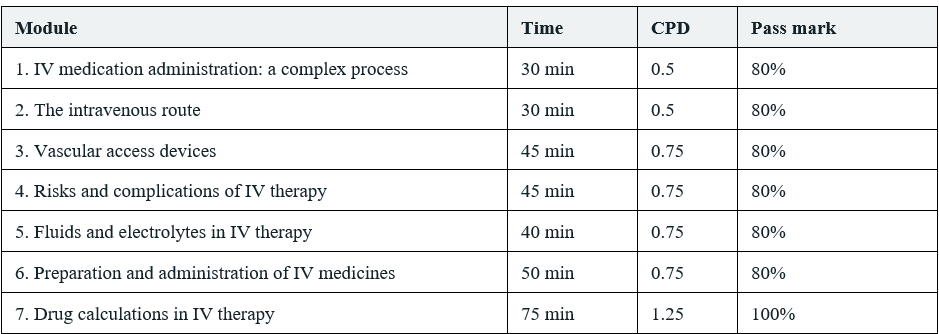
Getting help
For questions about the course content,or problems logging in or launching, contact askaltheducation@gmail.com.
To arrange the supervised practice that follows this course, print your certificate and speak with your line manager.